
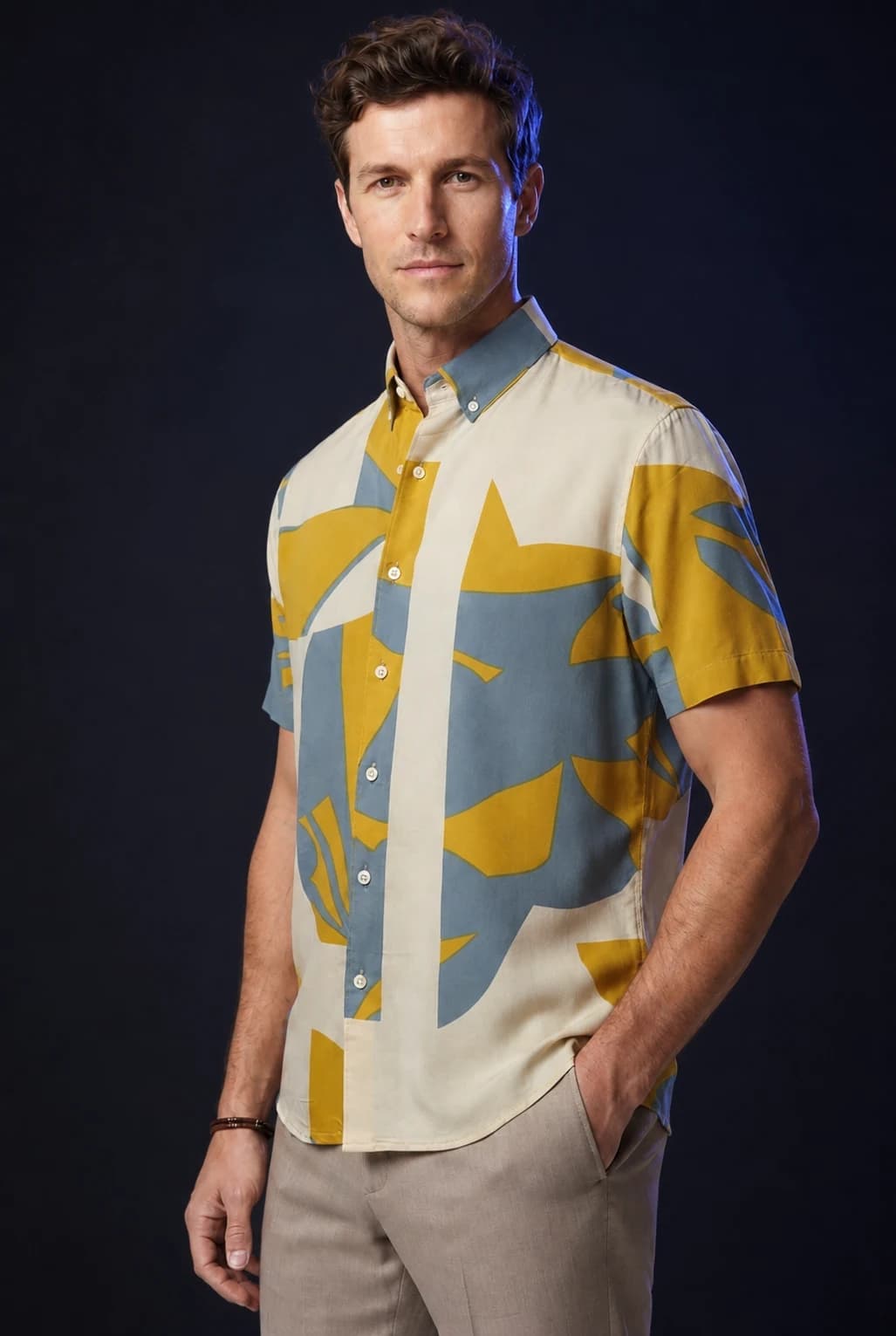
Spend a few seconds on this Forever 21 dress listing and you may feel it: the model is a little too smooth, the fabric a little too obedient, the movement not quite physical.
A viral LinkedIn post called the imagery AI-generated. But the honest answer is less satisfying: we cannot prove that from the pixels alone. At the time of review, the product page did not identify the model, credit a studio or disclose an AI workflow.
Forever 21 is certainly using generative AI elsewhere. An agency case study describes producing hundreds of test ads for the retailer in less than a day and reports 66% higher ROI, 71% higher click-through and 19% better cost per click. But that evidence applies to its advertising operation—not necessarily this particular dress or person. Monks’ Forever 21 case study
That ambiguity is the real story. Fashion’s adoption of synthetic imagery is moving faster than its system for explaining where the synthetic parts begin and end.
“AI-generated” is almost a useless description
Consider Mango’s first AI campaign for its Teen line, which the company described as “generated entirely” with AI.
The actual workflow was more interesting. Mango first photographed every physical garment. It then trained a generative model to place those real garments on models. Finally, its art team selected, retouched, edited and mastered the results in the company’s photography studio. Mango’s production breakdown
So was the campaign synthetic? Yes. Was it made without photography, real clothing or human art direction? No.
Elsewhere, the recipe changes completely.
H&M has generated digital twins of consenting real models. Guess placed a fully synthetic model in a two-page advertisement in the August 2025 print edition of Vogue. Etro used AI to construct the surreal environments and figures of its Spring/Summer 2024 “Nowhere” campaign. And retailers such as OTTO are generating ordinary-looking e-commerce model shots from a single product photograph.
These uses belong to the same technological family but make very different promises:
- An imaginary campaign world is selling a mood.
- A synthetic model is selling an aspiration.
- A digital twin is licensing a real person’s identity.
- A product-page image is telling shoppers how a garment fits, falls and moves.
Treating all four as simply “AI imagery” conceals the part that matters.
The economics are difficult to ignore
In 2013, Amazon opened a 40,000-square-foot fashion studio in Brooklyn. Its annual report proudly noted that 28 shooting bays produced an average of 10,413 photographs per day. It was an industrial image factory, but it was still constrained by studios, samples, cameras, models and hours. Amazon’s 2013 annual report
Generative production attacks each of those constraints.
Zalando says approximately 70% of its editorial campaign assets in Q4 2024 were AI-generated. One executive told Reuters that generative production reduced turnaround from six to eight weeks to three or four days—and cut costs by 90%. These are company-reported figures, but they explain the urgency rather well. Zalando’s disclosure, Reuters’ report
German retailer OTTO has gone further. Its in-house system needs one photograph of the original product, after which a user can choose a model, body shape, age, ethnicity and pose. OTTO says it can now create five times more content per day and reduce production costs by as much as 60%. Collections can appear online within hours. OTTO’s announcement
At that point, imagery stops behaving like a photoshoot and starts behaving like software: generated on demand, reformatted by channel, localized by market and multiplied into endless variants.
That capability is especially potent for ultra-fast-fashion platforms. During one six-month period in 2021, Shein added between 2,000 and 10,000 SKUs to its app every day, often beginning with batches of only a few dozen physical garments. Rest of World’s investigation
Producing conventional model photography for a catalogue moving at that speed is expensive. Producing another generated image is almost frictionless.
The output is not literally infinite. Human review, product references, computing and art direction still cost money. But the marginal cost of the next variation is collapsing—and that is enough to transform the industry.
The model may be fake, borrowed or both
Synthetic people attract most of the attention, but digital twins may prove more consequential.
H&M announced plans to create twins of 30 models. Under its proposed arrangement, the models would own the rights to their replicas and be paid each time they were used. In July 2025, H&M released its first campaign featuring those twins, accompanied by behind-the-scenes material and the names of participating creatives. ITV on the rights and payment model, H&M’s campaign announcement
Zalando is piloting a related system. It scans real models, combines their replicas with high-quality product photography and retains human involvement in creative direction and review. The model Marylou Moll described it as a way to participate in multiple shoots simultaneously; her agency presented it as an additional income stream.
This is a more defensible model than conjuring a diverse-looking cast while paying no diverse humans. But it does not make the labor question disappear. A model’s scan can eliminate future work for photographers, stylists, makeup artists and production crews even when the model herself is compensated.
In a preliminary Model Alliance poll of more than 100 models and influencers, roughly one in five said they had already been asked to submit to body scans. The organization argues that written consent must cover the purpose, duration, compensation and permitted manipulation of any digital replica. Model Alliance research
Levi Strauss discovered how quickly this conversation can turn. Its 2023 announcement of a partnership with Lalaland.ai framed synthetic models partly as a way to show more body types and skin tones. After backlash, Levi’s added an editor’s note saying the pilot had been misrepresented: it was not a diversity strategy, would not replace live shoots and should not substitute for hiring real people. Levi Strauss’ amended announcement
The lesson was blunt: generating the appearance of representation is not the same as distributing work, money or power.
Guess’s synthetic Vogue campaign exposed another trap. The agency behind it told ABC that experimenting with more varied body types and facial features caused its monthly reach to fall from 10 million views to one million. That is the agency’s own account, not an independently audited experiment. Still, it illustrates the feedback loop: generate what wins engagement, then use the engagement data to justify generating more of the same. ABC’s reporting
AI can produce any face in theory. In practice, optimization may drag fashion back toward its narrowest beauty standards.
A campaign can bend reality. A product page cannot.
The most important line is not between human and machine. It is between inspiration and product evidence.
A fantasy campaign has always been artificial. Locations are retouched. Bodies are reshaped. Garments are pinned, steamed and composited. AI increases the degree of invention, but shoppers already understand that a billboard is not a technical document.
A product detail page is different. Its images implicitly answer practical questions:
How sheer is the fabric? Where does the waist sit? Does the material crease? How does the hem move? Is that embroidery or a print?
If generation changes those attributes, it is no longer merely improving the photograph. It is improving the product.
The US Federal Trade Commission evaluates not only the words in an advertisement but also its pictures and implied claims. Material representations about a product’s features must be supported. The FTC has separately warned that when an image appears to demonstrate how a product performs, the visual itself must be truthful. FTC advertising guidance, FTC guidance on visual demonstrations
That does not automatically make an AI model shot deceptive. A system grounded in accurate photographs may represent a garment very well. But a tiny “AI-generated” label cannot repair a false impression about fit, texture or construction.
The operational danger is equally real. In 2025, Shein removed a product image that appeared to use the face of Luigi Mangione on a model selling a roughly $10 shirt. Shein said the image came from a third-party vendor and launched an investigation. ABC could not conclusively establish how it was made, although an expert assessed it as possibly a real face placed on an AI-generated body. ABC News
This was not just a bad prompt. It was a provenance and quality-control failure inside a content supply chain.
Soon, the clothing may not exist either
The next step is already being tested.
Alibaba researchers have described a deployed system called “sell it before you make it.” Merchants generate clothing designs and photorealistic images of digital models from text, list the concepts, and manufacture an item only after it receives enough orders.
The researchers report relative improvements of more than 13% in both click-through and conversion compared with human-designed items. They also note that customers are generally unaware of whether a product originated through generation. Alibaba researchers’ paper
This reverses the traditional sequence:
Design → manufacture → photograph → sell
becomes:
Generate → advertise → measure demand → manufacture
It could reduce unwanted inventory. It could also turn online shops into vast testing grounds filled with products that are visually finished but physically hypothetical.
In the US, the FTC’s guidance on “dry testing” says advertisements for merely planned merchandise should clearly disclose that it may never be produced or shipped. The image may be generated; the obligation to tell the truth is not.
What responsible use actually looks like
Fashion brands do not need another vague “AI principles” page. They need provenance at the asset level.
A credible system would do four things:
-
Describe what changed. “AI-generated” is insufficient. Say whether the model, body, garment, pose, background or movement was generated or altered.
-
Anchor product claims in reality. Generated model shots should be accompanied by unaltered packshots, close-ups and measurements from the physical item. The further an image moves down the funnel, the stricter its accuracy threshold should become.
-
License people like people. Digital-twin agreements need explicit scope, payment, duration, approval and revocation terms—not perpetual permission hidden inside a standard photoshoot release.
-
Keep an auditable trail. Brands should know the source photographs, model releases, generation tools, vendors and human approvers behind each published asset. “A supplier sent it” is not a provenance system.
A useful customer-facing disclosure might be refreshingly plain:
AI-assisted image. The model and setting are synthetic. The garment is based on photographs of the physical product. See studio images for unaltered details.
Some brands will reject the technology altogether. Aerie has made that position part of its identity, pledging not to use AI to generate bodies or alter people in its imagery. In a synthetic feed, reality can become a differentiator too. Aerie’s “No AI” commitment
Fashion has largely solved the technical problem of generating attractive imagery. It has not solved advertising.
Brands can now make nearly unlimited pictures of nearly unlimited people wearing nearly unlimited clothes. They still get one chance to tell the shopper which parts are real.